Browse the notebook

Tag: flash

QuickBox2D Editor

When I first created QuickBox2D I simultaneously developed a simple editor to aid in the creation of complex simulations. The result is very alpha and should be used cautiously. There is no UI, it is entirely key controlled. It generates actionscript files that can be copy and pasted into working simulations. It also has a preview mode for previewing simulations as you develop them. This is by no means a full featured editor, there is a good deal of work to be done on it. I am releasing the code as a simple zip for people who would like to develop it further. If there is enough interest I’ll create some kind of code repositiory, but for now I’m just releasing the below zip.

Take a look at the editor

Download the Source

I may post further instructions for the editor in the future… Remember to save your work frequently and to create new versions for every change that you make to a file.

Suggested Features:
Simple GUI
Base64 encoding for get string

Known Issues:
Making joints that don’t touch things can break the preview app.
Read snippet: QuickBox2D Editor

Gesture Capture Performance

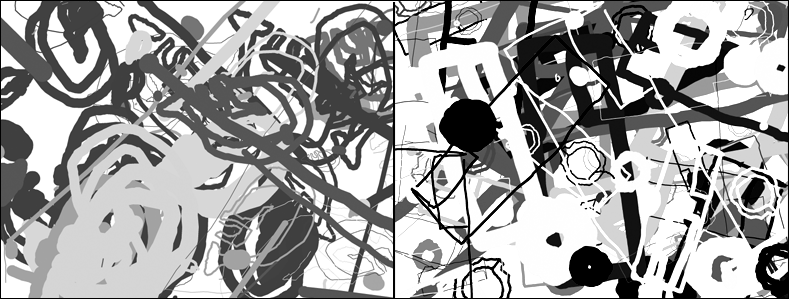
I’ll be doing a drawing performance using something I created called Gesture Capture tomorrow April 9th in Brooklyn at the former Engine Co. 212 firehouse. The performance will happen at random intervals between 6pm and 10pm. There will be two other performances going on by Julie Fotheringham, Vera Angelica and Zahava Rozman. Here is some additional information:

Gesture Capture Video and Information
Engine 212 Northside Town Hall Website
google map

Read snippet: Gesture Capture Performance

Recursion Form

x = y = 10
graphics.lineStyle(1,0);
drawBox(6);

function drawBox(iter:Number=10, count:Number=1, y:Number=0, w:Number=500):void{
       if (count < iter){
               var width:Number = w / count
               for (var i:int = 0; i<count; i++){
                   graphics.drawRect(i * width, width * count/w, width, width);
               }
               count++;
               drawBox(iter, count, y, width);
       }
}

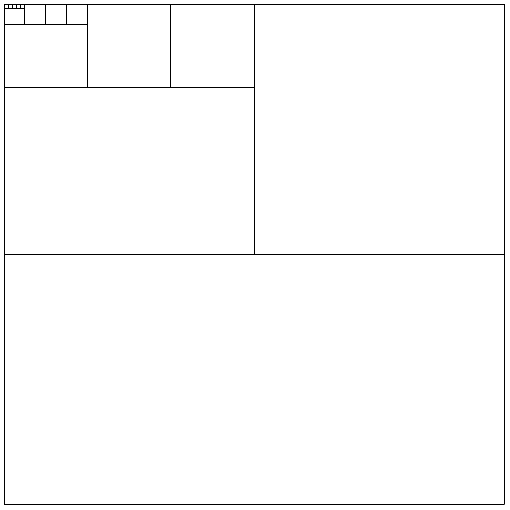
This small snippet just draws this image:

If you have an idea for a short recursive snippet. Feel free to post it in the comments.

Read snippet: Recursion Form

Logistic Map Play

var offX:Number = 100;
var offY:Number = 300;
var scalarX:Number = 6;
var scalarY:Number = 200;
addEventListener(Event.ENTER_FRAME, onLoop);
function onLoop(evt:Event):void{
	var r:Number = mouseY / 100;
	var xn:Number = (mouseX - 100) / 650;
	var xn1:Number = 0;
	graphics.clear();
	graphics.lineStyle(0,0);
	for (var i:int = 0; i<100; i++){
	  xn1 = r * xn * (1 - xn);
	  xn = xn1;
	  if (i == 0){
		graphics.moveTo(offX+i*scalarX,offY+xn1*scalarY);  
	  }else{
		graphics.lineTo(offX+i*scalarX, offY+xn1*scalarY);
	  }
	}
}

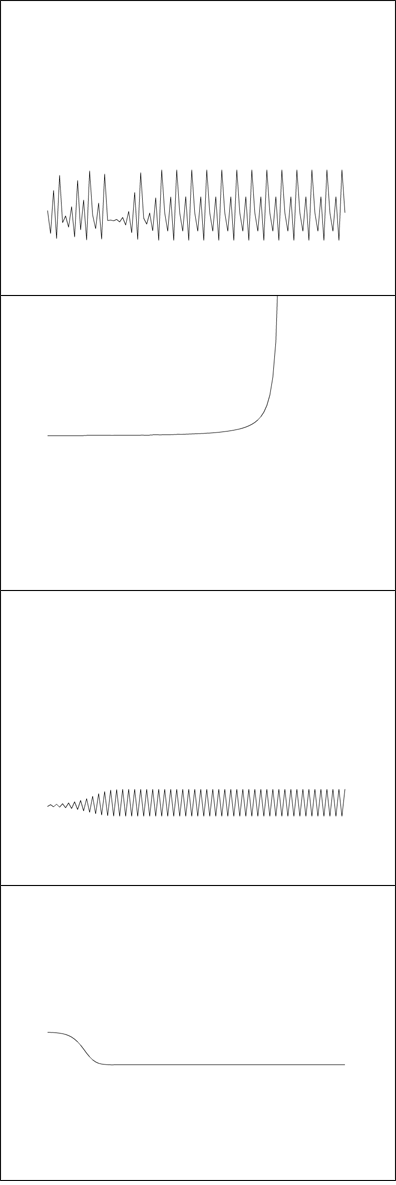
Whenever I can’t decide what kind of snippet to make, I simply go to wikipedia or mathworld for a bit and I always end up with something. I’ve messed with Logistic Maps before (when learning about strange attractors). This is a simple rendering where the x and y axis change the biotic potential (r) and the starting value for x.

Here is the link I used for reference.


Have a look at the swf (just move your mouse around).

Read snippet: Logistic Map Play

Connect The Dots E8

[SWF(width = 500, height = 500)]
const TWO_PI:Number = Math.PI * 2;
var centerX:Number = stage.stageWidth / 2;
var centerY:Number = stage.stageHeight / 2;
addEventListener(Event.ENTER_FRAME, onLoop);
function onLoop(evt:Event):void{
	// data
	var points:Array = [];
	var i:int = 0;
	var pointNum : int = Math.max(2,int(mouseX / 12))
	
	var radius:Number = 200;
	var step:Number = TWO_PI / pointNum;
	var theta:Number = step / 2;
	for (i = 0; i<pointNum; i++){
		var xp:Number = centerX + radius * Math.cos(theta);
		var yp:Number = centerY + radius * Math.sin(theta);
		points[i] = new Point(xp, yp);
		theta += step;
	}
	// render
	graphics.clear();
	graphics.lineStyle(0,0);
	for ( i = 0; i<pointNum; i++){
     var a:Point = points[i];
     for (var j:int = 0; j<pointNum; j++){
        var b:Point = points[j];
        if (a != b){
		   graphics.drawCircle(a.x, a.y, 10);
		   graphics.moveTo(a.x, a.y);
	       graphics.lineTo(b.x, b.y);
        }
     }
   }
}

I’ve been using this geometric shape for lots of different things recently. Including during consulting gigs as a helpful visualization. Just move your mouse left and right… I particularly like the simpler forms you get by moving your mouse to the left (triangles squares and simple polygons):

Connect The Dots – wonderfl build flash online

While not entirely related this wikipedia article is interesting.

[EDIT : Thanks to martin for reminding me that I can do away with the if statement here in the above code ]

graphics.clear();
graphics.lineStyle(0,0);
for (i = 0; i<pointNum; i++) {
	var a:Point=points[i];
	for (var j:int = i+1; j<pointNum; j++) {
		var b:Point=points[j];
		graphics.drawCircle(a.x, a.y, 10);
		graphics.moveTo(a.x, a.y);
		graphics.lineTo(b.x, b.y);
	}
}
graphics.drawCircle(a.x, a.y, 10);

I implemented that change over at wonderfl and it works nicely

Read snippet: Connect The Dots E8

Nonsense Clocks

[SWF(width = 500, height=500, backgroundColor=0x000000)]

var clockNum:int = 100;
var clocks:Vector.<Function> = new Vector.<Function>(clockNum, true);

var clockContainer:Sprite = Sprite(addChild(new Sprite()));
clockContainer.x = stage.stageWidth / 2;
clockContainer.y = stage.stageHeight / 2;
buildClocks();
runClocks();

function buildClocks():void{
	for (var i:int = 0; i<clockNum; i++){
		var theta:Number = Math.random() * Math.PI * 2;
		var radius:Number = Math.random() * 200;
		var xp:Number = radius * Math.cos(theta);
		var yp:Number = radius * Math.sin(theta);
		clocks[i] = makeClock(xp,yp,Math.random() * Math.PI * 2);
	}
}
function runClocks():void{
	addEventListener(Event.ENTER_FRAME, onRunClocks);
}
function onRunClocks(evt:Event):void{
	for (var i:int = 0; i<clockNum; i++){
		clocks[i]();
	}
	clockContainer.rotationX = clockContainer.mouseY / 30;
	clockContainer.rotationY = -clockContainer.mouseX / 30;
}
function makeClock(x:Number, y:Number, time:Number=0):Function{
	var radius:Number = Math.random() * 20 + 5;
	var border:Number = radius * 0.2;
	var smallRadius:Number = radius - radius * 0.3;
	
	var clock:Sprite = Sprite(clockContainer.addChild(new Sprite()));
	clock.x = x;
	clock.y = y;
	clock.z = 100 - Math.random() * 200;
	clock.rotationX = Math.random() * 40 - 20;
	clock.rotationY = Math.random() * 40 - 20;
	clock.rotationZ = Math.random() * 360;
	return function():void{
		with (clock.graphics){
			clear(); 
			lineStyle(1,0xFFFFFF); 
			drawCircle(0,0,radius + border);
			var xp:Number = smallRadius * Math.cos(time/2);
			var yp:Number = smallRadius * Math.sin(time/2);
			moveTo(0,0);
			lineTo(xp, yp);
			xp = radius * Math.cos(time);
			yp = radius * Math.sin(time);
			moveTo(0,0);
			lineTo(xp, yp);
		}
		time+=0.1;
	}
}


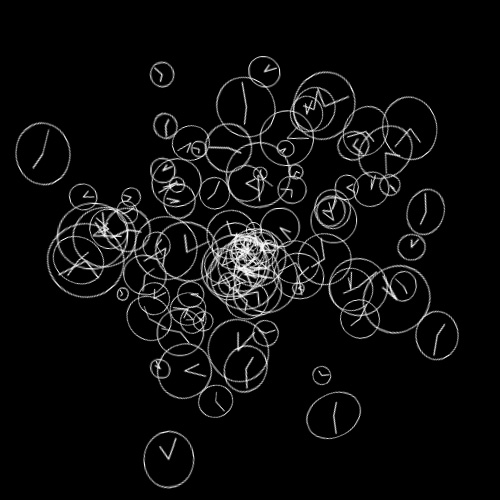
You can go check the swf out at wonderfl.net…

Read snippet: Nonsense Clocks

Clock Quiz

Here is a quick sunday quiz. Create some kind of clock with as little code as possible. Even just a textfield and the date object would cut it, but preferably try to do something a little more interesting. Post your results in the comments. I’ll post my version on monday EOD.

[EDIT: my clock can be found here which I’ll count as tomorrows post]

The last clock post I did was about the 24 hour clock have a look at that here.

Read snippet: Clock Quiz