Browse the notebook

Month: June 2009

Drawing a Half-Circle

graphics.beginFill(0xFF0000);
halfCircle(graphics, 200,200, 100);
// original circle function by senocular (www.senocular.com) from here http://www.actionscript.org/forums/showthread.php3?s=&threadid=30328
function halfCircle(g:Graphics, x:Number,y:Number,r:Number):void {
	var c1:Number=r * (Math.SQRT2 - 1);
	var c2:Number=r * Math.SQRT2 / 2;
	g.moveTo(x+r,y);
	g.curveTo(x+r,y+c1,x+c2,y+c2);
	g.curveTo(x+c1,y+r,x,y+r);
	g.curveTo(x-c1,y+r,x-c2,y+c2);
	g.curveTo(x-r,y+c1,x-r,y);
	// comment in for full circle
	/*g.curveTo(x-r,y-c1,x-c2,y-c2);
	g.curveTo(x-c1,y-r,x,y-r);
	g.curveTo(x+c1,y-r,x+c2,y-c2);
	g.curveTo(x+r,y-c1,x+r,y);*/
};

A quick way to draw a half-circle… I used to use this to draw circles in flash before the Graphics.drawCircle() method.

Read snippet: Drawing a Half-Circle

Strange BitmapData Drawing Instructions

// instructions
var ins:Array = [0,
-1, 100, 200, 3, 100, 0, 50, 1, 100, -1, 100, 150, 0, 50,
-1, 160, 200, 0, 50, 3, 50, 2, 50, 3, 50, 0, 50,
-1, 220, 200, 0, 50, 3, 50, 2, 50, -1, 270, 150, 3, 50, 2, 50];

var canvas:BitmapData = new BitmapData(400,400,false, 0xCCCCCC);
addChild(new Bitmap(canvas));

var index:int = 0;
var penX:int = 0;
var penY:int = 0;

read();

function read():void{
	var i:int, xp:int, yp:int;
	if (ins[index+1] == -1){
		 index++;
		xp = ins[++index];
		yp = ins[++index];
	}else{
		xp = penX;
		yp = penY;
	}
	var dir:int = ins[index];
	var leng:int = ins[++index];
	for (i = 0; i<leng; i++){
		if (dir == 0){
			xp += 1;
		}else if (dir == 1){
			yp += 1;
		}else if (dir == 2){
			xp -= 1;
		}else if (dir == 3){
			yp -= 1;
		}
	    canvas.setPixel(xp, yp, 0x000000);
     }
	 penX = xp;
	 penY = yp;
	if (index < ins.length){
		read();
	}
}

I was thinking today about alternative ways to represent drawings and I wrote this snippet while brainstorming. The function read() looks through an array of instructions (ins[]) and draws an image. In this case the letters AS3 are drawn to a Bitmap using setPixel().

The instructions work like this:

The first value of the array is ignored – it can be set to 0, or used to store some other info.
If the next value is a -1, the following two values in the array are used as a sort of moveTo().
This is followed by a direction value 0 = right, 1 = down, 2 = left, 3 = up.
Lastly there is a length value in pixels.

If no -1 is found, the read() function assumes that the value is for a direction.

So to draw a line from (100, 100) to (150, 100) you would write:
[0, -1, 100, 100, 0, 50]

To then draw a line down 50 pixels from the endpoint of the previous line you would add 1 (move down), 50 (length 50)… so you to end up with:
[0, -1, 100, 100, 0, 50, 1, 50]

and so on…

I’m not sure really where I was going with this, but it was fun to write…
Read snippet: Strange BitmapData Drawing Instructions

QuickBox2D Tetris Pieces

import com.actionsnippet.qbox.*;

[SWF(backgroundColor=0x000000, width=700, height=600, frameRate=60)]

var sim:QuickBox2D = new QuickBox2D(this);

sim.setDefault({fillColor:0x003366, lineColor:0x2B80D5, isBullet:true});
sim.createStageWalls();

var shapes:Array = [];
shapes[0] = [[1,1,1,1]];
shapes[1] = [[1, 0, 0], [1, 1, 1]];
shapes[2] = [[0, 0, 1], [1, 1, 1]];
shapes[3] = [[1, 1], [1, 1]];
shapes[4] = [[0, 1, 1], [1, 1, 0]];
shapes[5] = [[0, 1, 0], [1, 1, 1]];
shapes[6] = [[1, 1, 0], [0, 1, 1]];
var cols:Array = [0xFF0000,  0xFFFF00, 0xFF00FF, 0x0000FF, 0x00FF00,0x00FFFF, 0x00FF00,0xFAA703];
var angs:Array =  [0, Math.PI / 2, Math.PI, Math.PI + Math.PI / 2];
var bev:BevelFilter = new BevelFilter();
with (bev) blurX = 10, blurY = 10, strength = 0.5;

var inc:int = 9;
for (var i:int = 0; i<shapes.length; i++){
	sim.setDefault({fillColor:cols[inc % cols.length]});
	inc++
	makePiece(shapes[i], 3 + i * 3, 3);
	sim.setDefault({fillColor:cols[inc % cols.length]});
	inc++
	makePiece(shapes[i], 3 + i * 3, 8);
}

function makePiece(pattern:Array, xp:Number, yp:Number, scale:Number = 0.7):QuickObject{
	var parts:Array = [];
	for (var i:int = 0; i<pattern.length; i++){
		for (var j:int = 0; j<pattern[i].length; j++){
			if (pattern[i][j] == 1){
				parts.push(sim.addBox({x:j * scale, y:i * scale, width:scale, height:scale, restitution:0, friction:1, isBullet:true}));
			}
		}
	}
	var ang:Number = angs[int(Math.random()*angs.length)];
	var piece:QuickObject =  sim.addGroup({objects:parts, x:xp, y:yp, angle:ang});
	
	piece.userData.filters = [bev];
	return piece;
}

sim.start();
sim.mouseDrag();

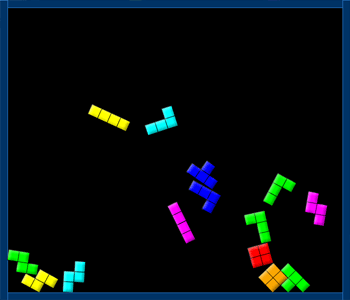
This snippet uses the QuickBox2D library to create some Tetris pieces.


Have a look at the swf here…

Read snippet: QuickBox2D Tetris Pieces

Tetris Sand CA

stage.frameRate = 30;
scaleX = scaleY = 2.5;
var canvas:BitmapData = new BitmapData(200,200,false, 0x000000);
addChild(new Bitmap(canvas));
var w:int = canvas.width;
var size:int = canvas.width * canvas.height;
var read:Vector.<uint> = new Vector.<uint>(size);
var write:Vector.<uint> = new Vector.<uint>(size);

read = canvas.getVector(canvas.rect);
var loc:int = 199*w;
for(var i:int = 0; i <= 200; i++){
       read[loc+i]=0xFFFFFFFF;
}
write = read.concat();

var shapes:Array = [];
shapes[0] = [[1,1],[1,1]];
shapes[1] = [[1,1,1,1]];
shapes[2] = [[1],[1],[1],[1]];
shapes[3] = [[1,1,1],[0,1,0]];
shapes[4] = [[1,0],[1,1],[1,1],[0,1]];
shapes[5] = [[1,0,0],[1,1,1]];
shapes[6] = [[1,1,0], [0,1,1]];
shapes[7] = [[1,1], [1,0],[1,0]];
function drawShape(xp:int, yp:int, pattern:Array, col:uint):void{
	var i:int = 0;
	var loc:int = xp + yp * w;
	if (int(Math.random()*2) == 1){
		pattern.reverse();
	}
	if (int(Math.random()*2)){
		for (i= 0; i<pattern.length; i++){
			pattern[i].reverse();
		}
	}
	for (i = 0; i<pattern.length; i++){
		 for (var j:int = 0; j<pattern[i].length; j++){
			 if (pattern[i][j] == 1){
				write[loc + i * w + j] = col;
			 }
		}
	}
}

var counter:int = 0;
addEventListener(Event.ENTER_FRAME, onLoop);
function onLoop(evt:Event):void {
	 var i:int;
     canvas.lock();
	 if (counter % 20 == 1){
		for ( i= 0; i<20; i++){
			 drawShape(5+  i * 10, 10, shapes[int(Math.random() * shapes.length)], Math.random()*0xFFFFFF);
		}
	 }
	 counter++;
	 read = write.concat();
	 for (i = 0; i<size; i++){
		 var curr:uint = read[i];
		 if (curr != 0xFF000000 && curr != 0xFFFFFFFF){
			var below:uint = read[i + w];
			if (below == 0xFF000000 || below == curr){
			  var above:uint = read[i - w];
			  if (above == 0xFF000000){
				 write[i] = 0xFF000000;
			  }
			  write[i + w] = curr;
			}else{
				var index:uint;
				if (int(Math.random()*2) == 1){
					index = i + w - 1;
				}else{
					index = i + w + 1;
				}
				if (read[index] == 0xFF000000){
					write[index] = curr;
				}
			}
		 }
	 }
	 canvas.setVector(canvas.rect, write);
	 canvas.unlock();
}

Quickly thrown together sand cellular automata – with some tetris shapes.

Read snippet: Tetris Sand CA

Distance Line Gradient

[SWF(width=600,height=500,frameRate=30)]
var canvas:BitmapData=new BitmapData(400,400,false,0x000000);
addChild(new Bitmap(canvas));

var size:Number=canvas.width*canvas.height;
var w:Number=canvas.width;
var pix:Vector.<uint> = new Vector.<uint>(size);
 
addEventListener(Event.ENTER_FRAME, onLoop);
function onLoop(evt:Event):void {
	canvas.lock();
		
 	var i:int = size;
	var x1:Number=mouseX;
	var y1:Number=mouseY;
	var x2:Number=250;
	var y2:Number=250;
	var dx:Number=x2-x1;
	var dy:Number=y2-y1;
	var denom:Number =  1/(dx * dx + dy * dy);
	if (dx==0&&dy==0) {
			x2+=1;
			y2+=1;
			dx=dy=1;
	}

	while( --i > -1 ){
		var xp:int= i % w;
		var yp:int = i / w;
		var u:Number = ((xp - x1) * dx + (yp - y1) * dy) * denom;

		var closestX:Number;
		var closestY:Number;
		if (u<0) {
			closestX=x1;
			closestY=y1;
		} else if (u > 1) {
			closestX=x2;
			closestY=y2;
		} else {
			closestX=x1+u*dx;
			closestY=y1+u*dy;
		}
		var dfx:Number=closestX-xp;
		var dfy:Number=closestY-yp;
		var d:Number=255-Math.sqrt(dfx*dfx+dfy*dfy);
		if (d<0) d=0;
		 pix[i]=uint(d);
	}
	canvas.setVector(canvas.rect, pix);
	canvas.unlock();
}

This didn’t come out as interesting as I thought it would for some reason – just used the technique from the last two posts to draw a gradient. Event though it’s visually boring, it does show how I went about inlining the function from yesterday… so I figured I’d post it.

Read snippet: Distance Line Gradient

Distance Between Point and Line (optimized)


/**
Original function by Pieter Iserbyt:
http://local.wasp.uwa.edu.au/~pbourke/geometry/pointline/DistancePoint.java
from Paul Bourke's website:
http://local.wasp.uwa.edu.au/~pbourke/geometry/pointline/
*/
function pointToLineDist(x1:Number, y1:Number, x2:Number, y2:Number,x3:Number, y3:Number):Number {
	var dx:Number=x2-x1;
	var dy:Number=y2-y1;
	if (dx==0&&dy==0) {
		x2+=1;
		y2+=1;
		dx=dy=1;
	}
	var u:Number = ((x3 - x1) * dx + (y3 - y1) * dy) / (dx * dx + dy * dy);

	var closestX:Number;
	var closestY:Number;
	if (u<0) {
		closestX=x1;
		closestY=y1;
	} else if (u > 1) {
		closestX=x2;
		closestY=y2;
	} else {
		closestX=x1+u*dx;
		closestY=y1+u*dy;
	}
	dx=closestX-x3;
	dy=closestY-y3;
	return Math.sqrt(dx * dx +  dy * dy);
}

/**
Test out the function
*/

var dotA:Sprite = dot(100, 100);
var dotB:Sprite = dot(200, 200);
var dotC:Sprite = dot(150, 100, 0x0000FF);
var txt:TextField = TextField(dotC.addChild(new TextField()));
with(txt) x = 5, y = 5, autoSize = "left", selectable = false, mouseEnabled = false;

addEventListener(Event.ENTER_FRAME, onLoop);
function onLoop(evt:Event):void {
	graphics.clear();
	graphics.lineStyle(0,0x000000);
	graphics.moveTo(dotA.x, dotA.y);
    graphics.lineTo(dotB.x, dotB.y);
	txt.text = pointToLineDist(dotA.x, dotA.y, dotB.x, dotB.y, dotC.x, dotC.y).toFixed(2);
}

// draggable dot
function dot(xp:Number, yp:Number, col:uint = 0xFF0000, rad:Number=4):Sprite {
    var s:Sprite = Sprite(addChild(new Sprite));
    s.x = xp;
    s.y = yp;
    with(s.graphics) beginFill(col), drawCircle(0,0,rad);
    s.buttonMode = true;
    s.addEventListener(MouseEvent.MOUSE_DOWN, onDrag);
    return s;
}
function onDrag(evt:MouseEvent):void { evt.currentTarget.startDrag() }
stage.addEventListener(MouseEvent.MOUSE_UP, onUp);
function onUp(evt:MouseEvent):void{stopDrag() }

This is the same as yesterdays post about the distance between a point and a line segment. I just took a few minutes to optimize the function – it runs close to 3X faster now. For more info see yesterdays post.

Read snippet: Distance Between Point and Line (optimized)

Distance Between Point and Line Segment

/**
Original function by Pieter Iserbyt:
http://local.wasp.uwa.edu.au/~pbourke/geometry/pointline/DistancePoint.java
from Paul Bourke's website:
http://local.wasp.uwa.edu.au/~pbourke/geometry/pointline/
*/
function pointToLineDistance(p1:Sprite, p2:Sprite, p3:Sprite):Number {
	var xDelta:Number = p2.x - p1.x;
	var yDelta:Number = p2.y - p1.y;
	if ((xDelta == 0) && (yDelta == 0)) {
		// p1 and p2 cannot be the same point
		p2.x += 1;
		p2.y += 1;
		xDelta = 1;
	        yDelta = 1;
	}
	var u:Number = ((p3.x - p1.x) * xDelta + (p3.y - p1.y) * yDelta) / (xDelta * xDelta + yDelta * yDelta);
	var closestPoint:Point;
	if (u < 0) {
	    closestPoint = new Point(p1.x, p1.y);
	} else if (u > 1) {
	    closestPoint = new Point(p2.x, p2.y);
	} else {
	    closestPoint = new Point(p1.x + u * xDelta, p1.y + u * yDelta);
	}
	return Point.distance(closestPoint, new Point(p3.x, p3.y));
}

/**
Test out the function
*/

var dotA:Sprite = dot(100, 100);
var dotB:Sprite = dot(200, 200);
var dotC:Sprite = dot(150, 100, 0x0000FF);
var txt:TextField = TextField(dotC.addChild(new TextField()));
with(txt) x = 5, y = 5, autoSize = "left", selectable = false, mouseEnabled = false;

addEventListener(Event.ENTER_FRAME, onLoop);
function onLoop(evt:Event):void {
	graphics.clear();
	graphics.lineStyle(0,0x000000);
	graphics.moveTo(dotA.x, dotA.y);
    graphics.lineTo(dotB.x, dotB.y);
	txt.text = pointToLineDistance(dotA, dotB, dotC).toFixed(2);
}

// draggable dot
function dot(xp:Number, yp:Number, col:uint = 0xFF0000, rad:Number=4):Sprite {
    var s:Sprite = Sprite(addChild(new Sprite));
    s.x = xp;
    s.y = yp;
    with(s.graphics) beginFill(col), drawCircle(0,0,rad);
    s.buttonMode = true;
    s.addEventListener(MouseEvent.MOUSE_DOWN, onDrag);
    return s;
}
function onDrag(evt:MouseEvent):void { evt.currentTarget.startDrag() }
stage.addEventListener(MouseEvent.MOUSE_UP, onUp);
function onUp(evt:MouseEvent):void{stopDrag() }

Last night I was working late and found myself in need of a way to calculate the distance between a point and a line. After a quick google search I found myself once again on Paul Bourke’s extremely useful website. I was in a rush, so I just quickly ported the java code (by Pieter Iserbyt) and wrote this test snippet to make sure it works.

This code could be optimized a bit, but it works nicely.

I needed this for a commercial project, but as I was porting the code I thought of an interesting way to use this code to draw a gradient – may write and post that tomorrow.

Read snippet: Distance Between Point and Line Segment

Calculate Slope of a Line

// calculate the slope of a line
function calculateSlope(x1:Number, y1:Number, x2:Number, y2:Number):Number {
        // rise over run
	var s:Number = (y1 - y2) / (x1 - x2);
	/*if (x1==x2) {
		// slope is Infinity or -Infinity
	}*/
	return s;
}

/**
 Test it out
*/
function draw(x1:Number, y1:Number, x2:Number, y2:Number):void {
	graphics.moveTo(x1, y1);
	graphics.lineTo(x2, y2)
	var txt:TextField =TextField(addChild(new TextField()));
	txt.text = calculateSlope(x1, y1, x2, y2).toFixed(2);
	txt.x = x2, txt.y = y2;
}

graphics.lineStyle(0,0xFF0000);
draw (100, 100, 200, 200);

draw(100, 100, 200, 150);

draw(100, 100, 200, 100);

draw(100, 100, 99, 200);

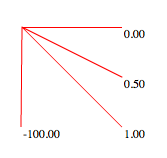
This snippet shows how to calculate the slope of a line … It demos the function by drawing a few lines and showing the corresponding slope of each.

It will draw this:

If (x1 == x2), the slope will be -Infinity or Infinity… depending on where you’re using this calculation you may want to reset the s variable to something else, return null etc… I commented it out for simplicity.

Read snippet: Calculate Slope of a Line

for loop Fun

var leng:int = 10;
for (var i:int = 0, j:int = leng;  i < leng; i++, j = leng - i){
	trace(i, j);
}

/*outputs
0 10
1 9
2 8
3 7
4 6
5 5
6 4
7 3
8 2
9 1
*/

Looping backwards and forwards.

Read snippet: for loop Fun