Many years ago when I had just started programming I found this absolute gem by Andries Odendaal.
modern es6 version
let rotX = 0, rotY = 0,
    perspective = 500,
    depth,
    currX, currY;
// learned something like this at Andries Odendaal's www.wireframe.co.za
function point3d(x, y, z) {
    let cosX = Math.cos(rotX),
        cosY = Math.cos(rotY),
        sinX = Math.sin(rotX),
        sinY = Math.sin(rotY),
        posX, posY, posZ;

    posZ = z * cosX - x * sinX,
    posX = z * sinX + x * cosX,
    posY = y * cosY - posZ * sinY,
    posZ = y * sinY + posZ * cosY;

    depth = 1 / (posZ / perspective + 1);
    currX = posX * depth;
    currY = posY * depth;

    return [ currX, currY, depth ];
}
Here’s is an example of it in action:
I’ve used this code many many times, it’s just easy to throw into any language and instantly get 3d points rendered in 2d. Here is a short video of a Java applet from 2003 called “Catch Env” that made use of it:
Here is the source code for that ^^
http://www.zevanrosser.com/shape2/j/Catchenv.java
You’ll notice in that source, that I nested the equation to allow for local and global transformations. It was around that time that I learned the ins and outs of real 2D and 3D matrix transformation math… Ken Perlin’s classfiles from NYU were a real help when I was learning that stuff. I don’t think this was the exact file I was working with, but it was definitely on his site somewhere.
Before all that, during my junior year in college I created a 3d engine based off Odendaal’s code in Director (Lingo). Here is a video of some of the demos for it:
…and here is a strange screenshot from my personal website at the time:
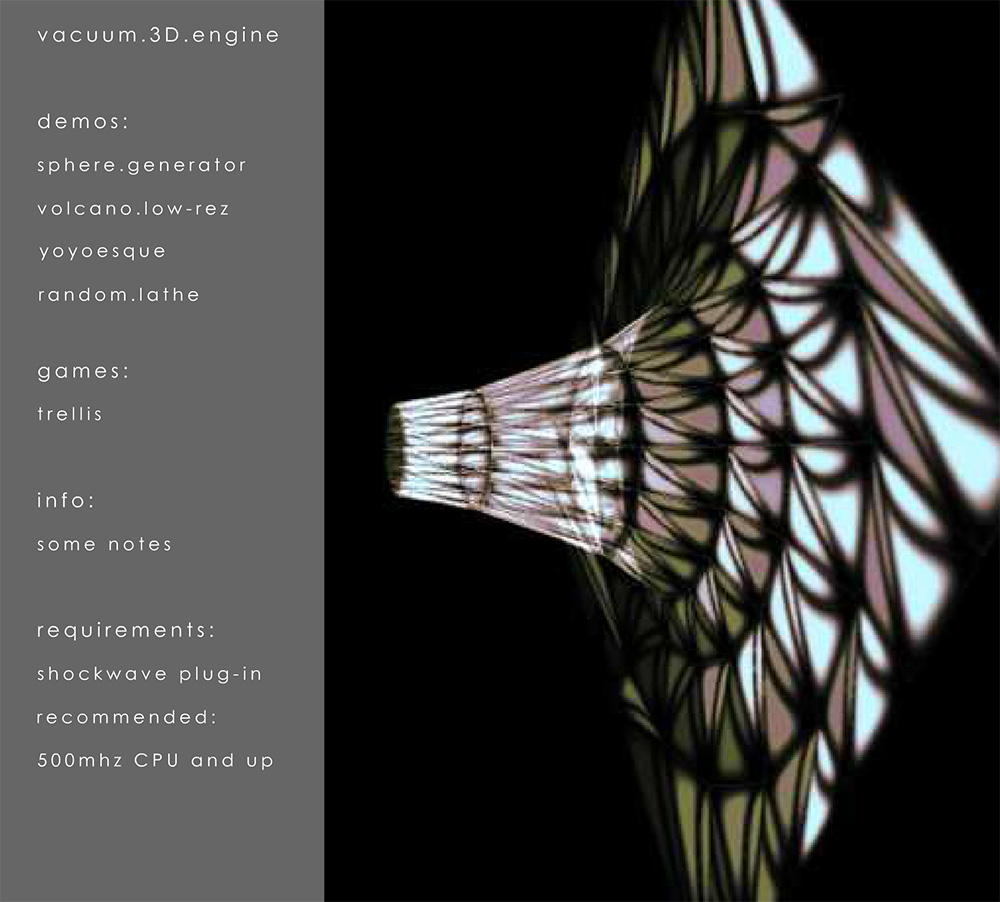
Just an example of a powerful snippet and a gateway to learning matrix transformation math. When I first really dug in to html5 canvas – before WebGL was supported so widely – having this trick up my sleeve was great. As you can see in the below link, I used it more than a few times back then:
Daily canvas experiments:
http://zreference.com/projects/all-graphics.php
😀