Browse the notebook

Tag: Box2D

QuickBox2D Tetris Pieces

import com.actionsnippet.qbox.*;

[SWF(backgroundColor=0x000000, width=700, height=600, frameRate=60)]

var sim:QuickBox2D = new QuickBox2D(this);

sim.setDefault({fillColor:0x003366, lineColor:0x2B80D5, isBullet:true});
sim.createStageWalls();

var shapes:Array = [];
shapes[0] = [[1,1,1,1]];
shapes[1] = [[1, 0, 0], [1, 1, 1]];
shapes[2] = [[0, 0, 1], [1, 1, 1]];
shapes[3] = [[1, 1], [1, 1]];
shapes[4] = [[0, 1, 1], [1, 1, 0]];
shapes[5] = [[0, 1, 0], [1, 1, 1]];
shapes[6] = [[1, 1, 0], [0, 1, 1]];
var cols:Array = [0xFF0000,  0xFFFF00, 0xFF00FF, 0x0000FF, 0x00FF00,0x00FFFF, 0x00FF00,0xFAA703];
var angs:Array =  [0, Math.PI / 2, Math.PI, Math.PI + Math.PI / 2];
var bev:BevelFilter = new BevelFilter();
with (bev) blurX = 10, blurY = 10, strength = 0.5;

var inc:int = 9;
for (var i:int = 0; i<shapes.length; i++){
	sim.setDefault({fillColor:cols[inc % cols.length]});
	inc++
	makePiece(shapes[i], 3 + i * 3, 3);
	sim.setDefault({fillColor:cols[inc % cols.length]});
	inc++
	makePiece(shapes[i], 3 + i * 3, 8);
}

function makePiece(pattern:Array, xp:Number, yp:Number, scale:Number = 0.7):QuickObject{
	var parts:Array = [];
	for (var i:int = 0; i<pattern.length; i++){
		for (var j:int = 0; j<pattern[i].length; j++){
			if (pattern[i][j] == 1){
				parts.push(sim.addBox({x:j * scale, y:i * scale, width:scale, height:scale, restitution:0, friction:1, isBullet:true}));
			}
		}
	}
	var ang:Number = angs[int(Math.random()*angs.length)];
	var piece:QuickObject =  sim.addGroup({objects:parts, x:xp, y:yp, angle:ang});
	
	piece.userData.filters = [bev];
	return piece;
}

sim.start();
sim.mouseDrag();

This snippet uses the QuickBox2D library to create some Tetris pieces.
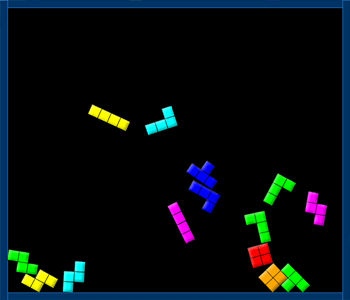

Have a look at the swf here…

Read snippet: QuickBox2D Tetris Pieces

QuickBox2D Groups

import com.actionsnippet.qbox.*;

[SWF (backgroundColor=0xAA0000, width=700, height=600, frameRate=60)]

var sim:QuickBox2D = new QuickBox2D(this);

sim.createStageWalls();

/**
create a dancing pill
*/
// all x and y coords are relative to the center of the group
var partA:QuickObject = sim.addCircle({x:-1, y:0, radius:0.5, restitution:.9});
var partB:QuickObject = sim.addCircle({x:1, y:0, radius:0.5, restitution:.9});
var partC:QuickObject = sim.addBox({x:0, y:0, width:2, height:1});
// all the parts are passed into the objects array
// addGroup() groups the parts together into one rigid body
var pill:QuickObject = sim.addGroup({objects:[partA, partB, partC], x:3, y:3, angle:0.3});

/**
create another group
*/
partA = sim.addCircle({x:0, y:0, radius:1});
partB = sim.addBox({x:0, y:1, width:1, height:1, fillColor:0x666666});
partC = sim.addBox({x:0, y:-1, width:1, height:1, fillColor:0x666666});
sim.addGroup({objects:[partA, partB, partC], x:8, y:3, angle:0.3});

/**
create two circles linked together by a stretchy joint
*/
partA = sim.addCircle({x:15, y:3, fillColor:0x000000, anglularDamping:1});
partB = sim.addCircle({x:17, y:3, fillColor:0xFFFFFF, anglularDamping:1});
// if x1, y1, x2 and y2 properties are not set, the joint is automatically placed
// at the b2Body's center
sim.addJoint({a:partA.body, b:partB.body, frequencyHz:1});

sim.start();
sim.mouseDrag();

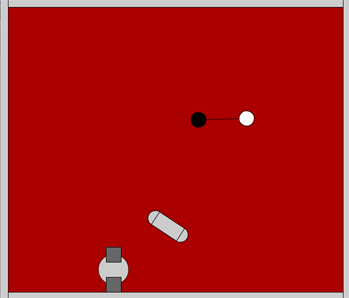
You’ll need QuickBox2D Alpha 106 to run this… This snippet demo’s the addGroup() method, which allows for easy grouping of shapes. I updated the docs today to feature a simple explanation of how this works.


Have a look at the swf here…

Read snippet: QuickBox2D Groups

QuickBox2D Play

import com.actionsnippet.qbox.*;
import Box2D.Common.Math.*;

[SWF (backgroundColor=0xaa0000, width=700, height=600)]

const TWO_PI:Number = Math.PI * 2;

var sim:QuickBox2D = new QuickBox2D(this,{gravityY:20, debug:false});

var i:int = 0;

// add some circles
var circles:Array = [];
var circleNum:int = 20;
for (i = 0; i<circleNum; i++){
	circles[i] = sim.addCircle({x: 8, y:-2 - i, radius:0.1 + Math.random()*0.4, fillColor:0x000000});
}

// add some boxes
var boxes:Array = [];
var boxNum:int = 20;
for (i= 0; i<boxNum; i++){
	var rx:Number = 4 + (i % 5) * 4;
	var ry:Number =  4 + int(i / 5) * 4;
	var ra:Number = Math.random() * TWO_PI;
	boxes[i] = sim.addBox({x:rx, y:ry, width:3, height:0.4, angle:ra, density:0,fillColor:0xFF2200});
}

// vector(0,0) used to reset velocity
var resetVec:b2Vec2 = new b2Vec2();

sim.start();
sim.mouseDrag();

addEventListener(Event.ENTER_FRAME, onLoop);
function onLoop(evt:Event):void {
	 // rotate all boxes
     for (i= 0; i<boxNum; i++){
		boxes[i].angle += .05; 
	 }
	 // move circles to top of sceen after they fall off bottom
	  for (i= 0; i<circleNum; i++){
		if (circles[i].y > 20){
			circles[i].y = -1;
			circles[i].x = Math.random()*(stage.stageWidth / 30 - 9) + 4;
			// access to Box2D b2Body methods
			circles[i].body.SetLinearVelocity(resetVec);
		}
	 }
}

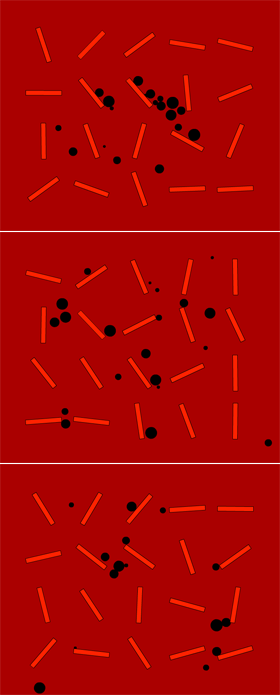
This is another QuickBox2D experiment. If you don’t know what QuickBox2D is … read about it here.

Take a look at the swf here

Read snippet: QuickBox2D Play

QuickBox2D Chain

import com.actionsnippet.qbox.*;

var sim:QuickBox2D = new QuickBox2D(this, {debug:true});
// use the box2D default renderer (debug : true)

sim.createStageWalls();

// anchor
var pre:QuickObject = sim.addCircle({x:9, y:3, radius:.5, density:0});

// create a chain of boxes
for (var i:int = 0; i<12; i++){
  var curr:QuickObject = sim.addBox({x:10 + i, y:3, width:.9, height:.9, angularDamping:1});
									                             
  // currently always adds a b2DistanceJoint
  sim.addJoint({a:pre.body, b:curr.body, 
			               x1:9 + i, y1: 3, x2: 10 + i, y2:3, collideConnected:false});
  pre = curr;
}

// add a circle, use CCD (isBullet)
sim.addCircle({x:20, y:10, radius:1, isBullet:true});

// start simulation
sim.start();
sim.mouseDrag();

This snippet uses my QuickBox2D library to create a chain. QuickBox2D is a wrapper for Box2DFlashAS3 that greatly simplifies world setup, instantiation and graphical skinning of rigid bodies (more info on yesterdays post)…

See the swf here .

Download Box2DFlashAS3 here

Download QuickBox2D Alpha 104 here

See yesterdays post for additional information. I’m still in the process of writing some docs and possibly a tutorial for QuickBox2D… hopefully I’ll finish with that soon…

If your somewhat familiar with Box2D and just want to just dig right in, the following scrap of information may help:


// Methods of the QuickBox2D class, used for creating rigid bodies and joints
addCircle();
addBox();
addPoly();
// currently only creates b2DistanceJoints
addJoint();

these function all take one parameter Object as their argument. The common parameter properties for rigid bodies are:

// QuickBox2D simpleRender settings:
lineColor:0x000000
lineAlpha:1
lineThickness:0
fillColor:0xCCCCCC
fillAlpha:1
// wrapped Box2D properties
x:3
y:3
density:1
friction:0.5
restitution:0.2
angle: 0
linearDamping:0
angularDamping:0
isBullet:false,
fixedRotation:false
allowSleep: true
isSleeping:false
// advanced use
maskBits:0xFFFF
categoryBits:1
groupIndex:0

//and the specific param properties are:
addCircle() : radius
addBox() : width, height
addPoly() : verts

//Joints have the following properties... not going to bother explaining these until I write the docs:
addJoint() : a, b, x1, x2, y1, y2

Read snippet: QuickBox2D Chain