Browse the notebook

Category: Number

Haskell Inspired zipWith() Function

initOperators();

trace(zipWith("-", [1,2,3], [1,2,3]));
trace(zipWith("+", [1,2,3], [1,2,3]));
trace(zipWith("*", [1,2,3], [1,2,3]));
trace(zipWith("+", [1,1,1,3], [4,5,6,7]));
trace(zipWith("<<", [2, 4], [1,1]));
/*
outputs:

0,0,0
2,4,6
1,4,9
5,6,7,10
4,8
*/

function zipWith(op:String, a:Array, b:Array):Array{
    var aLeng:int = a.length;
    var bLeng:int = b.length;
    var leng:Number = (aLeng < bLeng) ? aLeng : bLeng;
    var zipped:Array = [];
   
    if (!this[op])return [];
   
    for (var i:int = 0; i<leng; i++){
        zipped[i]=this[op](a[i], b[i]);
    }
    return zipped;
}

function initOperators():void{
    this["+"]=function(a:Number, b:Number):Number{ return a + b };
    this["-"]=function(a:Number, b:Number):Number{ return a - b };
    this["/"]=function(a:Number, b:Number):Number{ return a / b };
    this["*"]=function(a:Number, b:Number):Number{ return a * b };
    this["%"]=function(a:Number, b:Number):Number{ return a % b };
   
    this["&"]=function(a:Number, b:Number):Number{ return a & b };
    this["<<"]=function(a:Number, b:Number):Number{ return a << b };
    this["|"]=function(a:Number, b:Number):Number{ return a | b };
    this[">>"]=function(a:Number, b:Number):Number{ return a >> b };
    this[">>>"]=function(a:Number, b:Number):Number{ return a >>> b };
    this["^"]=function(a:Number, b:Number):Number{ return a ^ b };
}

This snippet is basically like the haskell zipWith() function. It can combines two arrays into one array given a single function. In this case I defined a bunch of operator functions, but it would work with any kind of function that takes two arguments and returns a value. You could extend this to work with strings and do other strange things I guess.

If you have yet to go play with haskell … go do it now.
Read snippet: Haskell Inspired zipWith() Function

Tausworthe Random Numbers (seeded)

// best thing about this are the random seeds
var s1:Number= 0xFFFFFF;
var s2:Number = 0xCCCCCC;
var s3:Number= 0xFF00FF;

// saw this algorithm on this somewhat annoying thread:
// http://www.reddit.com/r/programming/comments/7yjlc/why_you_should_never_use_rand_plus_alternative/
// additional googling brought me to this: http://wakaba.c3.cx/soc/kareha.pl/1100499906/
// and finally to this ( didn't understand most of this one) www.ams.org/mcom/1996-65-213/S0025-5718-96-00696-5/S0025-5718-96-00696-5.pdf

function rand():Number {
	s1=((s1&4294967294)<<12)^(((s1<<13)^s1)>>19);
	s2=((s2&4294967288)<<4)^(((s2<<2)^s2)>>25);
	s3=((s3&4294967280)<<17)^(((s3<<3)^s3)>>11);
	var r:Number = (s1^s2^s3) * 2.3283064365e-10;
	r = (r<0) ? r+=1 : r;
	return r;
}

// see a visual comparison between this and actionscript's Math.random()

var canvas:BitmapData = new BitmapData(400,400,false, 0xCCCCCC);
addChild(new Bitmap(canvas));

var posX:Number;
var posY:Number;

addEventListener(Event.ENTER_FRAME, onLoop);

function onLoop(evt:Event):void {

	for (var i:int = 0; i<100; i++){
		posX = rand() * 180
		posY = rand() * 180
		canvas.setPixel( 100 + posX, 10 + posY, 0x000000);
	}
	
	for (i = 0; i<100; i++){
		posX = Math.random() * 180
		posY = Math.random() * 180
		canvas.setPixel( 100 + posX, 210 + posY, 0x000000);
	}
}

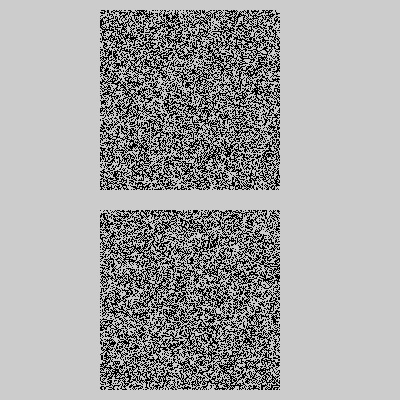
The above snippet demo’s an alternative random number generator that uses the Tausworthe method.


Top square is Tausworthe and bottom is Math.random()

I don’t actually know much about this, or fully understand how it works. I just saw it on a random reddit thread, googled about it for a few minutes and then ported it to actionscript.

There’s lots of talk about what the BEST random number generator is…. which one is the fastest, which one is the most random. etc… I don’t really know much about that, especially since I’m just playing around with code and I don’t need a RNG for some scientific experiment. For me, what’s nice about this approach is the three random seeds. For some reason, Math.random() doesn’t have a place where you can enter a seed for random numbers. Random seeds are very useful when you want to do something random but want to be able to replicate the random results at a later time. For instance:

var s1:Number= 0xFFFFFF;
var s2:Number = 0xCCCCCC;
var s3:Number= 0xFF00FF;

trace("first three values:");
trace(rand());
trace(rand())
trace(rand())

s1 = 0xFF;
s2 = 0xEFEFEF;
s3 = 19008;

trace("nfirst three values with different seeds:");
trace(rand());
trace(rand())
trace(rand())

s1 = 0xFFFFFF;
s2  = 0xCCCCCC;
s3 = 0xFF00FF;

trace("noriginal three values:");
trace(rand());
trace(rand())
trace(rand())

function rand():Number {
	s1=((s1&4294967294)<<12)^(((s1<<13)^s1)>>19);
	s2=((s2&4294967288)<<4)^(((s2<<2)^s2)>>25);
	s3=((s3&4294967280)<<17)^(((s3<<3)^s3)>>11);
	var r:Number = (s1^s2^s3) * 2.3283064365e-10;
	r = (r<0) ? r+=1 : r;
	return r;
}

/*
outputs:
first three values:
0.051455706589931385
0.050584114155822715
0.417276361484596

first three values with different seeds:
0.6032885762463134
0.9319786790304015
0.8631882804934321

original three values:
0.051455706589931385
0.050584114155822715
0.417276361484596
*/

I stumbled upon a bunch of other random number algorithms, maybe I’ll throw them in a class in the next couple days.

Read snippet: Tausworthe Random Numbers (seeded)

Adding Very Large Numbers

// tracing out large numbers will go into exponent notation
trace(1000000000000000000000000);
// outputs: 1e+24

var a:String =  "1000000000000000000000009";
var b:String = "12000000000000000000000001";

// bigAdd function adds two large numbers 
trace(bigAdd(a, b));
// outputs: 13000000000000000000000010

// unclear what regular addition is doing here:
trace(int(a) + int(b));
// outputs: -3758096384

function bigAdd(a:String, b:String):String{
       var answer:String="";
       var carry:int = 0;
	   var zeros:int = 0;
	   var i:int = 0;
	   var max:int = 0;
	    
		// obtain max variable and prepend zeros to the shortest string
	   if (a.length > b.length){
		  max = a.length;
		  zeros = max - b.length;
		   for (i= 0; i<zeros; i++) {
				b = "0" + b;
		   }
	   }else if (b.length >  a.length){
		   max = b.length;
		   zeros = max - a.length;
		   for (i= 0; i<zeros; i++) {
				a = "0" + a  ;
			}
	   }else{
		   // a and b have same number of digets
		   max = a.length;   
	   }
	   
	   // add each character starting with the last (max - 1), 
	   // carry the 1 if the sum has a length of 2
       for (i = max - 1;  i > -1; i--){ 
               var sum:String = String(int(a.charAt(i)) + int(b.charAt(i)) + carry);

               if (sum.length == 2){
                       answer = sum.charAt(1) + answer;
                       carry = 1;
               }else{
                       carry = 0;
                       answer = sum + answer;
               }
       }
	   if (carry == 1){
           answer = 1 + answer;
       }
       return answer;
}

This snippet demos a function called bigAdd(), which can be used to add very large numbers that the standard numerical datatypes (int, Number, etc) won’t really work with. It uses a string based addition algorithm.

When I decided to write this snippet I dug around for awhile trying to find a nice elegant algorithm to port, something done without prepending zeros etc…. but I couldn’t find one that suited my needs… so I just created this one from scratch. There’s room for optimization and improvement but it works well enough for just playing around.

BigDecimal & BigInteger

A few months back I needed to do some programming with very large numbers. I dug around for awhile and eventually found out that java has a built in BigInteger andBigDecimal class…. I used java to write the program I had in mind, but thought it would be fun to eventually create something similar for ActionScript….

Read snippet: Adding Very Large Numbers

10,000 35 ways, .toString(radix);

for(var i:int = 2; i<37; i++){
	trace((10000).toString(i));
}
/*
outputs:
10011100010000
111201101
2130100
310000
114144
41104
23420
14641
10000
7571
5954
4723
3904
2e6a
2710
20a4
1cfa
18d6
1500
11e4
kec
iki
h8g
g00
ekg
dja
cl4
bpo
b3a
aci
9og
961
8m4
85p
7ps
*/

I had either totally forgotten about or never known about the Number, uint, int etc… .toString() radix argument. Brock mentioned it to me in conversation and I’ve been having fun with it ever since. It’s especially nice for tracing out hex numbers:

var red:Number = 0xFF0000;
trace("decimal:");
trace(red);
trace("hex:");
trace(red.toString(16));
Read snippet: 10,000 35 ways, .toString(radix);

Number.toFixed()

var someValue:Number = 2.0480531167374427;

// want to show only 3 decimal places?
trace(someValue.toFixed(3)); // outputs 2.048

An easy way to get rid of extra decimal values. This is useful when you want to show decimal values in text fields. I only recently noticed this in the docs, I used to do this type of thing:

trace(int(someValue * 1000) / 1000);  // outputs 2.048
Read snippet: Number.toFixed()